Address: Victoria 3064, Australia
Tel: +61 42012 9435
ACN
634 651 031
ABN: 24 634 651 031

Address: Victoria 3064, Australia
Tel: +61 42012 9435
ACN
634 651 031
ABN: 24 634 651 031
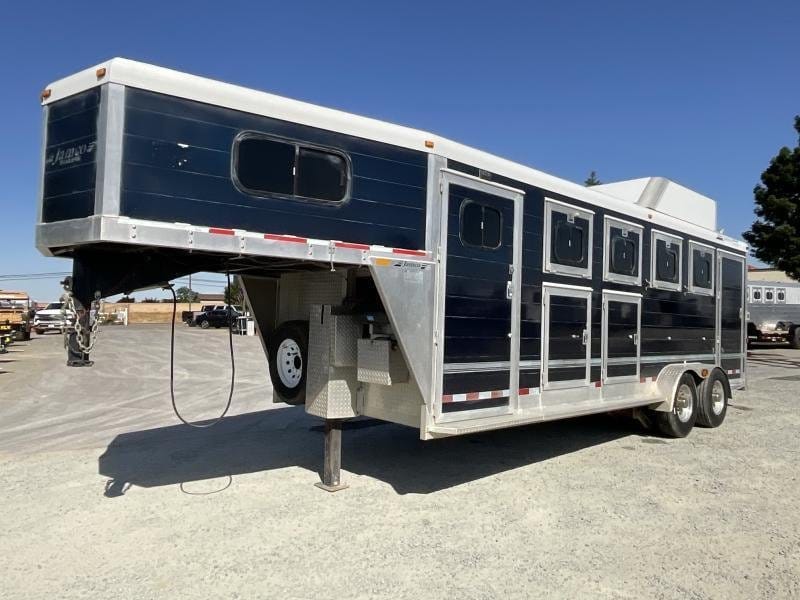
A horse float is one of the few purchases where getting it wrong is not just expensive — it is unsafe, for the horse and for everyone on the road behind you. The good news is that the decision comes down to a small number of questions, and most of them have clear answers once you know what you are looking at. This guide works through them in the order that matters.
Almost every bad float purchase starts by falling in love with a float and working backwards. Do it the other way round. Find your vehicle’s braked towing capacity and its towball download limit, then work out what the float will weigh loaded: the float itself, plus two horses at roughly 450–600 kg each, plus tack, feed, water, rugs and whatever else ends up in the front. It adds up faster than people expect, and an empty float weight tells you very little.
Leave margin rather than sitting on the limit. A rig at 95% of capacity behaves very differently on a wet road, in a crosswind, or when a truck passes you at 100 km/h. If the numbers are tight, that is an argument for an aluminium float, or for one bay fewer.
Buy for the travelling you do, not the travelling you imagine.
Angle load (slant load) floats stand horses on a diagonal, which makes the float shorter overall for the same number of bays — easier to tow, easier to reverse, easier to store. Many horses travel well on an angle because they can brace against the direction of travel.
Straight load floats give each horse a full-length bay facing forward, which suits taller and longer-bodied horses and horses that dislike being turned to load. They are longer for the same capacity. There is no universally correct answer — there is only what suits your horses, and if you have one that has always travelled well in a particular configuration, that is information worth more than any specification sheet.
A bumper-pull float couples to a conventional towbar. It is cheaper, tows behind a wider range of vehicles, and is what most two horse floats use. A gooseneck couples to a hitch mounted over the rear axle of a ute or truck tray, which puts a large share of the load ahead of the axle. The result is a markedly more stable tow at highway speed and on gravel, and far easier reversing. It also creates the short-wall space in front of the horses used for dressing rooms, tack walls and weekender living quarters.
The trade-offs are cost, a longer and taller combination, and the need for a suitable vehicle with the hitch installed. As a rule of thumb: two horses, bumper pull is fine; four horses, gooseneck; three horses, it depends on how far and how often you travel.
Steel is stronger for the money and can be repaired in any regional town, but it is heavier and the paint has to be maintained — particularly within sight of the coast. Aluminium saves substantial weight, which can be the difference between a comfortable tow and a marginal one, and it does not rust. It can suffer galvanic corrosion where dissimilar metals meet, and repairs are more specialised. Many American-built floats use an aluminium body on a steel frame, which is a sensible compromise and common in the stock we carry.
If you look at nothing else, look at these.
Many of the floats available in Australia — including most of the stock we carry — were originally built for the North American market by manufacturers such as Featherlite, Sundowner, Exiss, 4 Star, Shadow and Lakota. They are generally well built, and the imperial specifications in a listing are as published by the original manufacturer.
What you need to establish before you buy, rather than after, is what your state or territory transport authority requires for an imported trailer to be registered and used on the road, and what documentation exists for the specific unit. Registration, lighting, coupling, braking and compliance requirements are set by each state and are the buyer’s responsibility. Ask the seller what paperwork comes with the float; if you are looking at one of ours, tell us which listing and we will tell you exactly what it has.
Across our current range, two horse floats are listed from roughly A$2,800 to A$20,000, three horse floats from about A$3,760 to A$18,000, and four horse floats from about A$11,600 to A$34,000. Prices are live and in Australian dollars. On top of the purchase price, allow for a pre-purchase inspection, likely tyres and bearings on anything at the older end, any registration costs in your state, and delivery — ours is a flat A$450 to most Australian addresses.
A float that lives outside deteriorates faster than one that does not, and the floor is what suffers first. Park it level, sweep and dry it after every trip, lift the mats periodically rather than annually, and keep the coupling and jockey wheel greased. A great many properties end up putting a 20ft shipping container alongside the float as a dry, lockable feed and tack room — add racking and lighting and it comfortably outperforms a garden shed for both security and dryness. If you are moving gear rather than horses, an enclosed trailer is the tool for that job.
Send us your horses’ heights, the vehicle you tow with and how far you usually travel, and we will tell you honestly which size and configuration suits — including when the answer is a smaller float than you were planning to buy. Get in touch, or browse the current range of two, three and four horse floats.
